
Science & Longevity
Anti-Aging Prime: the science behind the formula
13 nutrigenomic ingredients. Five biological mechanisms. A precisely designed formula, without sweeping promises.

Ageing is not the result of a single process. Current research describes a network of molecular and cellular changes that influence one another over time.
In 2023, López-Otín and colleagues updated the Hallmarks of Aging framework to include 12 interconnected processes. Anti-Aging Prime does not claim to cover this entire framework. Its formulation rationale focuses on five selected biological areas relevant to its composition: energy metabolism, autophagy, senescence and inflammatory signalling, epigenetic regulation, and redox homeostasis.[1]
Following this logic, Ecogenetics brings together 13 nutrigenomic ingredients in a multi-component formula. Rather than assigning a global answer to ageing to one ingredient, the proposal starts from a more measured idea: biology is complex, and the formula should have a similarly structured rationale.
Important: references to cellular pathways and mechanisms in this article describe scientific research areas and the formulation rationale. They do not mean that the supplement has been clinically shown to modify, halt or reverse the mechanisms of ageing.
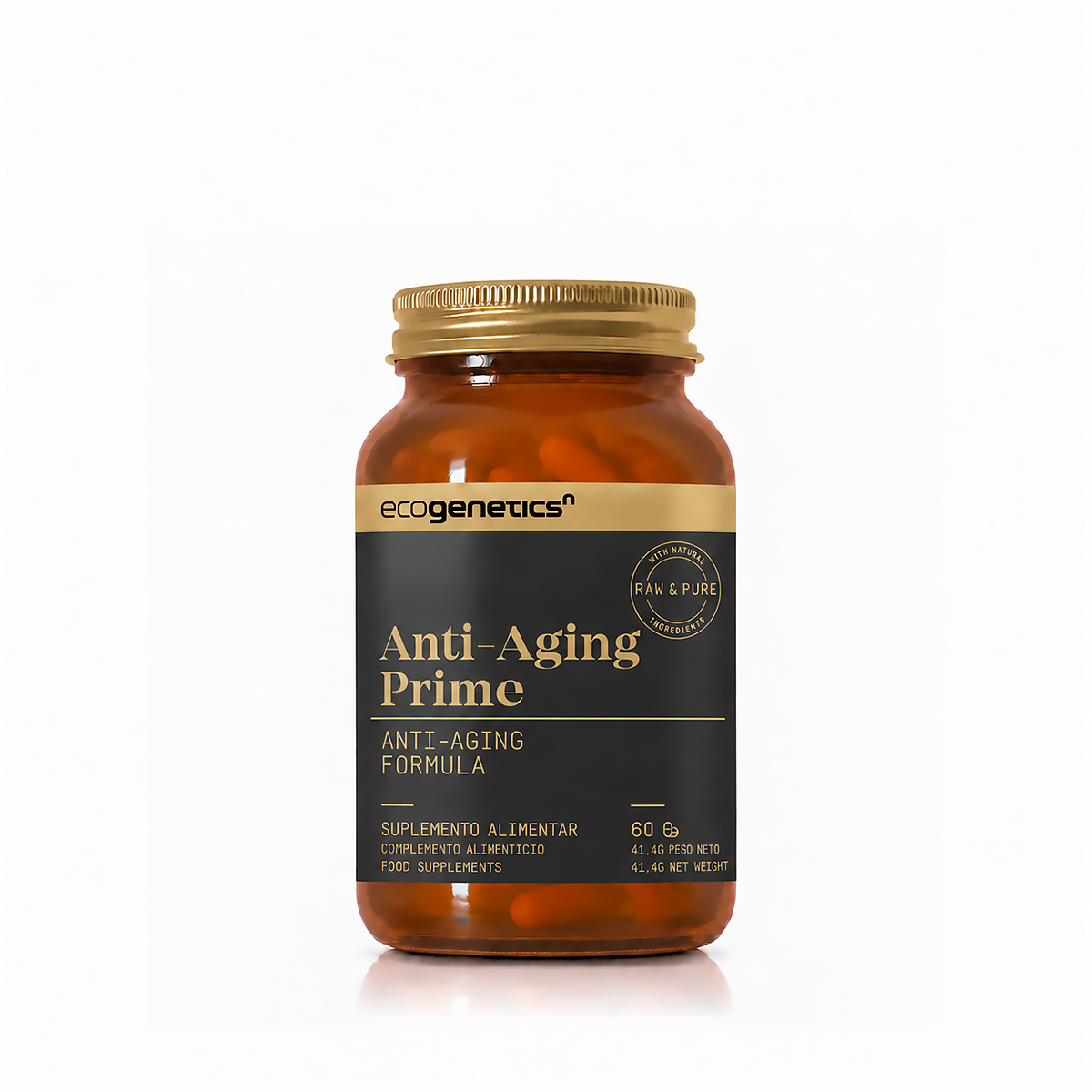
Anti-Aging Prime
A premium formula developed to bring research in nutrigenomics and the biology of ageing into a coherent, multi-component nutritional approach.
- 13 nutrigenomic ingredients
- 60 capsules
- Manufactured in the European Union under GMP certification
- Ecogenetics Raw & Pure identity
The rationale behind the formula, mechanism by mechanism

| Biological area | Nutrigenomic ingredients highlighted in the rationale | Scientific context |
|---|---|---|
| Energy metabolism and mitochondrial function | Liposomal NAD+, Pterostilbene, Shilajit | NAD+ metabolism, nutrient sensing and mitochondrial function are central areas of ageing research.[1][2] |
| Autophagy and cellular recycling | Spermidine, Quercetin, Ellagic acid | Autophagy helps break down and recycle cellular components and maintain homeostasis.[1][3] |
| Cellular senescence and inflammatory signalling | Quercetin, Magnolol, Honokiol, Carcinine (Glycoless®) | Cellular senescence and chronic inflammation are interconnected processes widely studied in the biology of ageing.[1][4] |
| Epigenetic regulation | NAD+, Pterostilbene, Glutathione | Epigenetic changes affect gene expression and are part of the current Hallmarks of Aging framework.[1][5] |
| Redox homeostasis and antioxidant response | Carcinine, Glutathione, L-taurine, Safranal | Redox homeostasis and the NRF2 pathway are studied in the context of cellular stress responses and ageing.[6] |
Some ingredients appear in more than one area because biological processes overlap. These associations summarise the formula’s technical rationale; they are not claims of a clinical effect of the product.
01 Energy metabolism and mitochondrial function
NAD+ is a coenzyme central to energy metabolism and also acts as a cofactor for enzymes involved in DNA repair, chromatin remodelling and cell signalling. NAD+ biology intersects with several areas relevant to ageing, although translation of these mechanisms into clinical benefits depends on the compound, dose, bioavailability and individual context.[2]
Liposomal NAD+, pterostilbene and shilajit are highlighted in this part of the Anti-Aging Prime rationale.
02 Autophagy and cellular recycling
Autophagy is a conserved cellular process that breaks down and recycles proteins, lipids and organelles. Its relationship with ageing, homeostasis and disease remains an active research area. Impaired macroautophagy is included in the 2023 Hallmarks of Aging review.[1][3]
Spermidine, quercetin and ellagic acid are associated with this research area in the formulation.
03 Cellular senescence and inflammatory balance
Senescent cells stop proliferating but may remain metabolically active and alter their tissue environment through secreted signals. Low-grade chronic inflammation also becomes increasingly relevant with age. The interaction between senescence and inflammatory signalling is therefore widely studied.[1][4]
Quercetin, magnolol, honokiol and carcinine (Glycoless®) feature in this part of the rationale. Markers and pathways such as NF-κB, IL-6 and TNF-α are often studied here, but that alone does not establish a clinical effect of the product on them.
04 Epigenetic regulation
DNA remains relatively stable, but the way genetic information is regulated can change over a lifetime. Changes in chromatin, DNA methylation and other epigenetic marks are studied in relation to age and the maintenance of cellular function.[1][5]
NAD+, pterostilbene and glutathione are included in this area of the Anti-Aging Prime rationale, where metabolism, redox state and epigenetic regulation are biologically connected.
05 Redox homeostasis and antioxidant response
Reactive oxygen species are not merely waste products: they also act as cellular signals. The challenge lies in the balance between physiological signalling and excessive oxidative stress. The KEAP1-NRF2 pathway is a major cellular response network and remains under investigation in ageing.[6]
Carcinine, glutathione, L-taurine and safranal are highlighted here. Scientific accuracy calls for describing a research context rather than claiming that the formula “activates NRF2” in consumers.
Why a multi-component formula?
The biology of ageing involves overlap and interdependence. A longevity formula can therefore be designed around several biological areas rather than a single compound. More ingredients are not automatically better: the quality of a formula depends on the selection, forms, quantities and quality of its raw materials, and on the coherence of the whole.
This is where Anti-Aging Prime aims to stand out: 13 nutrigenomic ingredients brought together within a common rationale, rather than an unconnected collection of ingredients.
Manufactured with rigour
Ecogenetics presents Anti-Aging Prime as a food supplement manufactured in the European Union under GMP certification, in line with the brand’s Raw & Pure identity. The aim is not to promise to stop time, but to translate research on ageing and nutrigenomics into a formula developed with quality and precision in mind.
Discover the Anti-Aging Prime formula
See the product presentation, composition and directions for use on the official Ecogenetics page.
View Anti-Aging PrimeScientific references
- López-Otín C, Blasco MA, Partridge L, Serrano M, Kroemer G. Hallmarks of aging: An expanding universe. Cell. 2023;186(2):243-278. doi: 10.1016/j.cell.2022.11.001.
- Covarrubias AJ, Perrone R, Grozio A, Verdin E. NAD+ metabolism and its roles in cellular processes during ageing. Nat Rev Mol Cell Biol. 2021;22(2):119-141. doi: 10.1038/s41580-020-00313-x.
- Aman Y, et al. Autophagy in healthy aging and disease. Nat Aging. 2021;1(8):634-650. doi: 10.1038/s43587-021-00098-4.
- Gorgoulis V, et al. Cellular Senescence: Defining a Path Forward. Cell. 2019;179(4):813-827. doi: 10.1016/j.cell.2019.10.005.
- Sen P, Shah PP, Nativio R, Berger SL. Epigenetic mechanisms regulating longevity and aging. Cell. 2016;166(4):822-839. doi: 10.1016/j.cell.2016.07.050.
- Schmidlin CJ, Dodson MB, Madhavan L, Zhang DD. Redox regulation by NRF2 in aging and disease. Free Radic Biol Med. 2019;134:702-707. doi: 10.1016/j.freeradbiomed.2019.01.016.